Tuesday, 2 September 2014
Delays!
Only a couple of posts in and I'm already running behind. Sorry, really busy long weekend and the previous week at work beat the heck out of me. Soon!

Tuesday, 19 August 2014
Episode One – Deadwood – Part Two
“I may have fucked my life up flatter than hammered shit...”
OK, lots of ground to cover with this
post, so I'm going to condense as best I can.
Special thanks to everyone who has
given me tips on how to wrangle these websites. I don't know if I've
gotten any better at it, but I guess they are starting to come
together.
Like I said last week, we're going to
cut to Al Swearengen, who is probably most people's favourite
character in the series. Al is a quintessential frontier force: he's
a civilizer. He's rough and rude and violent, and almost certainly a
terrible person, but underneath it all is a love for stability and
for structure. Al, as we will see, is a man of contradictions. As
with the other characters, this can be seen in his costume: when we
meet him, he's in a suit, and he's often seen in either a coat or
waistcoat or both. But that's just an illusion. Eventually, we'll see
Al pull the waistcoat over his long underwear, the same pair he
sleeps in. His veneer of civilization draped over the bare minimum.
He's also a contradiction when it comes to violence: we'll see him
act the peacemaker but order and commit murders. We'll see him
express genuine affection for someone he has brutalized.
If I were to hazard a guess, I would
say that the reason Al is so popular is because he is, in a broad
sense, all of humanity compressed into one little character. And of
course played to a preeminence by the brilliant Ian McShane.
 |
| Ian McShane as Al Swearengen |
When we meet Al, he's chatting with
Ellesworth, who is one of the local prospectors. Ellesworth has hit
it big, and he speaks lines to Al which, when I heard them, hooked me
on the show beyond anything else:
“I may have fucked my life up flatter
than hammered shit, but I stand here before you today beholden to no
human cocksucker and working a paying fucking gold claim.”
Again we see Milch and the rest of the
show's team laying everything on the line. “This,” they say, “is
what our show is all about. People who are wrecked and know it, but
who have come to this wild place and made something of themselves.”
Ellesworth then spends his new fortune on whiskey and gambling and
the attentions of prostitutes. Maybe Al doesn't have a monopoly on
representing humanity here.
A little subplot begins involving one
of the prostitutes – another one of our leads – a woman named
Trixie, and a gun. Unsurprisingly, some of the clients of the Gem are
not too kind to their companions, and this particular client was
beating on her. She had previously told him to stop, and now she
stops him for good with a bullet to the brain. Straight through the
brain. He dies, but not right away: he clings to life and sputters
out his last words, confused about his surroundings. Trixie gives up
her gun to Al, but not before he contrives to have the word spread
that the man killed himself. Later on, we'll see how Al deals with
Trixie's insubordination.
Two more of our growing cast are part
of this scene as well: Johnny, who is another of Al's lackeys, a
kind, somewhat dim-witted man; and Doc Cochran, a Civil War veteran
with a serious drinking problem and the standard level of class for
an illegal gold-rush town -- played by "hey it's that guy"/Grima Wormtongue Brad Dourif. The Doctor puts a probe through the dying
man's brain and muses how he wished he knew how the man lived so
long, but sets it aside by joking about how it won't matter to Mr.
Wu's pigs – the porcine fate of many corpses in Deadwood whose fate
Al and those close to him wish uninvestigated. When we later meet Mr.
Wu and his pigs, he and the doctor calmly throw the body in to their
enclosure; they certainly don't offer any ceremony.
 |
| Brad Dourif as Doc Cochran. |
Wild Bill, seeking whiskey, has come
with Charlie Udder into the camp. He checks into the Grand Central
Hotel, run by yet another series regular, E.B. Farnum. Farnum, we'll
find, is famous for three things: sweaty palms, slavish dedication to
Al Swearengen, and self-aggrandizement. As soon as Hickok checks in,
Farnum slinks to his master and lets Al know that the famous
gunfighter has arrived.
We see a few more quick scenes which
drive home what we already know: Al can be in turns vicious and
tender; Starr and Bullock are a natural team; Bullock prefers to
settle matters with cold words, backed up by the threat of violence,
but Starr is a natural defuser of tensions. Notably, Bullock is still
in black and white; Starr wears grey.
Yet another new character is
introduced: Bram Garret. Bram is a rich man from Back East; well,
his father is rich. Bram is here to make something of himself with
daddy's money, and find a paying gold claim. He is kitted up with new
fancy clothes and equipment, and he's becomes “friends” with Al
Swearengen and Dan Dorrity to achieve this end. Which is to say that
Al is running a scheme on him. The scheme is simple: a man called Tim
Driscoll offers to sell a worthless piece of land to Bram, and gold
is placed on the land where Bram will find it, to inflate the price.
Al brokers the deal, and Driscoll gets thirty percent. Farnum,
however, tries to help, and almost sours the deal. He makes a
counter-offer, trying to get Bram to offer more money. Luckily, Bram has the money, and does, but Al is clearly unimpressed with this act
of initiative on the part of his lackeys.
This scene is cross-cut with another
scene of haggling and self-destruction. Hickok and Udder find
themselves in Tom Nuttall's Number Ten Saloon. Seems that nobody can
fail to recognize Wild Bill, and soon Charlie is making a deal with
Tom that if Bill drinks and gambles exclusively at the Number Ten,
then Tom will pay a flat rate: some to Charlie and some to Bill.
Seems that Charlie is saving up a nest egg for his friend; Bill, on
the other hand. seems content to drink and gamble himself to death.
Our next new character for this episode
is Alma Garret, Bram's wife, played by the crush of every Canadian my age who likes women, Molly Parker. The first few times we see her, she's
drinking a golden tincture from a bottle: laudanum, one of many
panaceas of the 19th Century. When Bram enters the room to
tell her of his “success” in the negotiations, he sees her
drinking it, and exclaims “Banish all headaches!” Clearly, they
haven't been intimate for some time. The Garrets are pure fiction, with no precise historical analogues. I'll get to that in more detail later on.
 |
| Molly Parker as Alma Garret. |
Upset with Driscoll's scheme, Al tells
Dan that Driscoll needs to die. This is after Al talks Tim down from
his thirty percent to twenty dollars in cash, some time with a
prostitute, and to clear some of the debt he owes to the Gem. Poor
Driscoll cannot catch a break, and soon he will catch Dan's knife,
and be another gift to the hungry pigs.
In the hardware tent, Starr and Bullock
have done a fair night's trade, and are hiring a night watchman, a
man called Smith, whom we will get to know later. Smith is kind, but
odd, and his friendliness is undertoned with sadness: “The Lord is
our final solace, but it's a comfort having friends,” he says with
a smile. “I know that from past experience.” Ouch. Their
conversation is interrupted by a man on horseback who tells them that
he saw a wagon of people cut down and murdered on the road to
Spearfish. Smith identifies them as a group headed back to Minnesota;
Jane met them earlier in the episode.
Bullock takes the rider to the Number
Ten, where Hickok is playing poker. We get a glimpse of Hickok's
problem-solving technique, and it's unsurprisingly like Bullock's: he
uses stern words, backed up by the threat of violence, with an eye to
defusing a situation. One gets the impression, though, that Hickok
wants the violence even more than Bullock does. Like without it, he's
missing something in his life. Again, not subtle, this show. Jack
McCall, who you may know from history as the man who shot Wild Bill
Hickok, is losing to him in poker... or not. He pulls a third eight
and cracks “I mistakenly outdraw the greatest gunfighter in the
world.” Hickok is, of course, unimpressed.
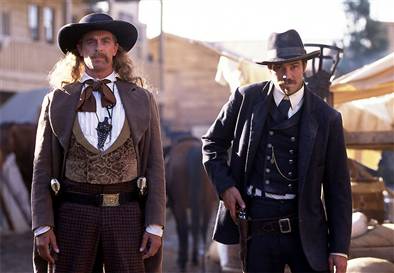 |
| Hickok and Bullock stand together. |
Bullock is trying to convince the rider
to take him back out to where the wagon was, and the party
slaughtered, because something Smith said suggested that there might
be one child still alive. Starr solves this problem by recounting
what the rider has already told them at full volume. This gets the
room riled up, but most essentially, it gets the attention of Bill
Hickok. Hickok and Bullock become quickly aligned: terse men of
violence, both previously lawmen. They agree to ride out with a small
group, including A.W. Merrick, the publisher and editor of, and sole
contributor to the Deadwood Pioneer.
Merrick has previously made himself known by pontificating on the
future of the town: that the gold and settlement in the territory
will force the US government to ignore the Laramie treaty and come
in, bringing the full weight of civilization into this wild space.
I
figure it's just the writers being clever and telling people who
don't know the history exactly what's going to happen next.
Well,
like Merrick, I appear to have run on. I do think I've finally
introduced all the major players, though. There's not a lot left to
the episode, but I'll stop before you all get bored, and next time I
can wrap up and still have some words to do analysis.
Until
next time!
Thursday, 14 August 2014
Episode One - Deadwood - part one
“No law at all in Deadwood... is that true?”
This first episode is really long. Well, no longer than any other: they are all one hour. But this one introduces basically all the characters and if you've seen the show then you'll remember that there are a lot of characters. What does that mean for you and me? It means that we're going to do episode one as two parts to keep things efficient.
A few other things: this show has some language. I'm sure if you've watched it, then you know. To make an impact, to show the rough edges of the characters, David Milch and his team put some serious fucking language into these scripts. I'm going to avoid some of it. Obviously not all of it, but you won't see me reproducing derogatory terms for sex workers, Aboriginal people, or Chinese people, unless it's a direct quote.
This first episode starts straight to opening credits. Most TV shows have a bit of a build-up, a teaser, to get you hooked on the premise of the episode before the opening, but not this one. That's a bold move, but interestingly, the title actually does a really great job of priming the viewer. See, HBO does opening credit sequences that are more visually- and musically-impressive than some entire shows. This sequence is one of them. We open on a wild horse, running between wagons, running through mud. It's untethered, and wears no saddle or tack. There are cuts: a bucket overrunning with blood; a man pulling out his own tooth; implied sex; women bathing; whiskey; and of course, gold. Throughout it all we return to the horse, still free. The final shot of the opening sequence is the horse, reflected in a surprisingly-clear puddle in front of a saloon with a cloth banner instead of a proper sign.
Already, we know so much about what is to come: this is a western; it's about freedom – the untethered horse; it's about sex and drink and greed and decay. This title sequence is the themes of Deadwood all summed up.
The next shot is of a small town at night. Our “lower-third” caption tells us that this is Montana Territory, 1876. Again, this tells us very much with very little. It tells us that Montana isn't a state: the American West remains “unsettled”, at least by colonists. It tells us that the American Civil War is twelve years done: adults will remember it, and any character in their late-twenties or older might have served. Probably everyone will have lost someone. Incidentally, to the best of my memory, this is the only such title in the series (I'll correct myself later if that's wrong).
 |
| Timothy Olyphant as Seth Bullock |
Here we get to know our first character, Seth Bullock, and through his dress and a few lines of dialogue, we get a sense of what kind of person he is: he's terse, efficient with language. He has an air of menace, but can be quite friendly in conversation. And when presented with an opportunity for fortune at the expense of the law, he rejects the offer. He's incorruptible... for now. His dedication is infectious. He's a natural leader, cowing an armed mob with little more than his will and a few choice words. “You called the law in, Samson,” he says. “You don't get to call it off just 'cause you're liquored up and popular on payday.”
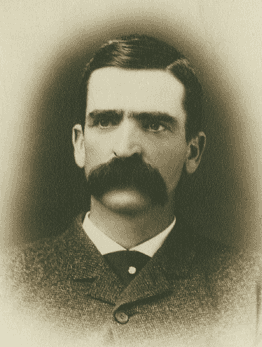 |
| The historical Seth Bullock, from Wikimedia Commons. |
We also get a glimpse of one of the things that makes this show famous, and one of my favourites: the overwrought dialogue. According to the extra features, some people thought the show was even written in iambic pentameter. It's not, but I can see how people might thing that it is.
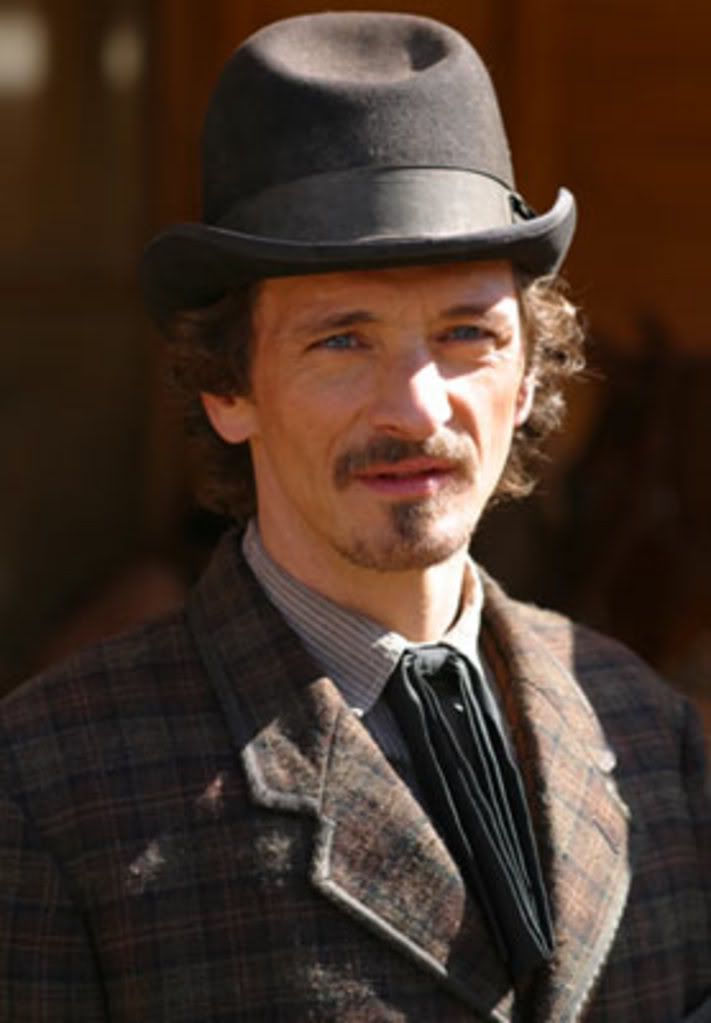 |
| John Hawkes as Sol Starr |
 |
| The historical Starr. Wikimedia Commons. |
 |
| Robin Weigert as Calamity Jane. |
 |
| "Calamity" Jane Cannary, Wikimedia Commons. |
Bullock is the first character we see come into town. He's framed by the graveyard. Subtle this show is not.
In the town, we see that the streets are mud, and used for livestock and the conduct of business. Several of the buildings are fronted by tents or otherwise under construction. We see a tent with a sign declaring it to be “baths”, and we see banners that read “coming soon,” “whiskey shots,” “Miners Assay Office & Chemical Laboratory,” and the like.
Starr and Bullock set to work finding a location for their hardware store. Good editing means they get one right away, and the rent is going to be $20 a day for what Sol assures Seth is a fine location. They pay their money to Dan Dority, who will be another series regular, and he tells them about Al Swearengen and the Gem Saloon. Al is a popular pick for best character, but I won't skip ahead.
In fact, I think I'll call part one to a close there! Hopefully this isn't too wordy or rambly. There's a lot of ground to cover. Please, comment, criticize, engage.
Until next time!
Tuesday, 5 August 2014
Greetings
 |
| The Deadwood Coach, from the Smithsonian Collection flickr: https://www.flickr.com/photos/smithsonian/2551128168/in/photolist-7HiVMZ-5jVRom-4Trcwq |
Here's how I envision this: every week or so, I'm going to watch an episode of the HBO series Deadwood. I'm going to make notes, and I'm going to turn those notes into short episode captions and essays. I'll post those here.
There are thirty-six episodes of Deadwood, and given that my schedule is likely to be sporadic, that ought to take me about a year. After that... I'm not sure.
It's also possible that I will pad the count by adding in related commentaries: essays about the themes of isolation, colonization, settlement, resource extraction; reviews of related media. That sort of thing.
I hope that sounds interesting to you.
Subscribe to:
Comments (Atom)