“No law at all in Deadwood... is that true?”
This first episode is really long. Well, no longer than any other: they are all one hour. But this one introduces basically all the characters and if you've seen the show then you'll remember that there are a lot of characters. What does that mean for you and me? It means that we're going to do episode one as two parts to keep things efficient.
A few other things: this show has some language. I'm sure if you've watched it, then you know. To make an impact, to show the rough edges of the characters, David Milch and his team put some serious fucking language into these scripts. I'm going to avoid some of it. Obviously not all of it, but you won't see me reproducing derogatory terms for sex workers, Aboriginal people, or Chinese people, unless it's a direct quote.
This first episode starts straight to opening credits. Most TV shows have a bit of a build-up, a teaser, to get you hooked on the premise of the episode before the opening, but not this one. That's a bold move, but interestingly, the title actually does a really great job of priming the viewer. See, HBO does opening credit sequences that are more visually- and musically-impressive than some entire shows. This sequence is one of them. We open on a wild horse, running between wagons, running through mud. It's untethered, and wears no saddle or tack. There are cuts: a bucket overrunning with blood; a man pulling out his own tooth; implied sex; women bathing; whiskey; and of course, gold. Throughout it all we return to the horse, still free. The final shot of the opening sequence is the horse, reflected in a surprisingly-clear puddle in front of a saloon with a cloth banner instead of a proper sign.
Already, we know so much about what is to come: this is a western; it's about freedom – the untethered horse; it's about sex and drink and greed and decay. This title sequence is the themes of Deadwood all summed up.
The next shot is of a small town at night. Our “lower-third” caption tells us that this is Montana Territory, 1876. Again, this tells us very much with very little. It tells us that Montana isn't a state: the American West remains “unsettled”, at least by colonists. It tells us that the American Civil War is twelve years done: adults will remember it, and any character in their late-twenties or older might have served. Probably everyone will have lost someone. Incidentally, to the best of my memory, this is the only such title in the series (I'll correct myself later if that's wrong).
 |
| Timothy Olyphant as Seth Bullock |
Here we get to know our first character, Seth Bullock, and through his dress and a few lines of dialogue, we get a sense of what kind of person he is: he's terse, efficient with language. He has an air of menace, but can be quite friendly in conversation. And when presented with an opportunity for fortune at the expense of the law, he rejects the offer. He's incorruptible... for now. His dedication is infectious. He's a natural leader, cowing an armed mob with little more than his will and a few choice words. “You called the law in, Samson,” he says. “You don't get to call it off just 'cause you're liquored up and popular on payday.”
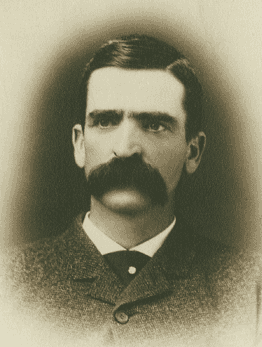 |
| The historical Seth Bullock, from Wikimedia Commons. |
We also get a glimpse of one of the things that makes this show famous, and one of my favourites: the overwrought dialogue. According to the extra features, some people thought the show was even written in iambic pentameter. It's not, but I can see how people might thing that it is.
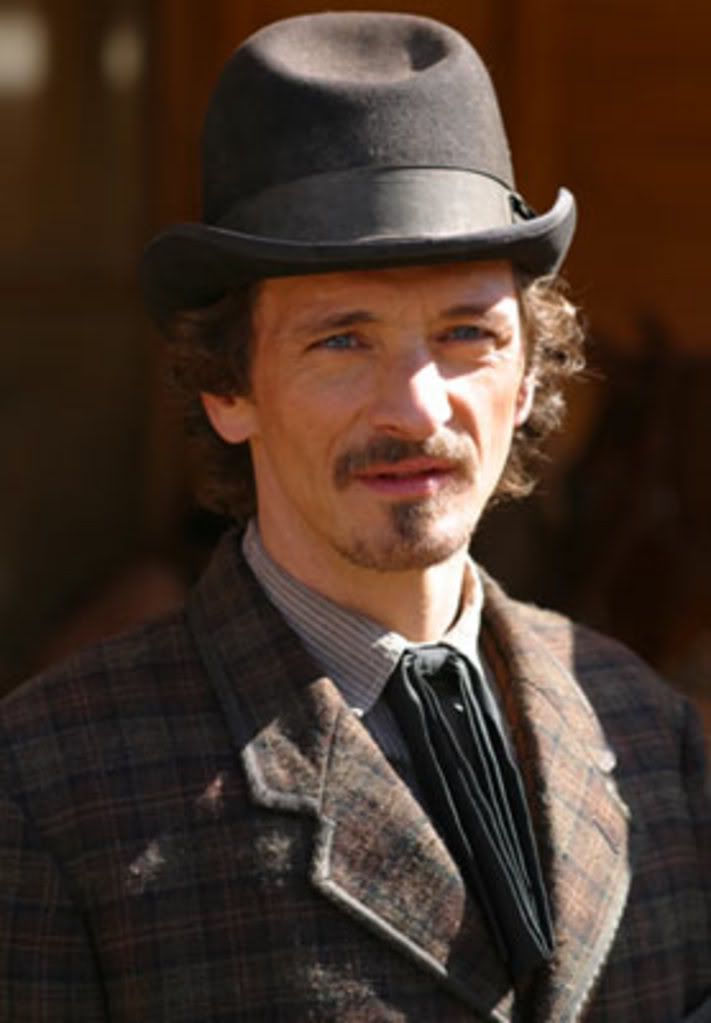 |
| John Hawkes as Sol Starr |
 |
| The historical Starr. Wikimedia Commons. |
 |
| Robin Weigert as Calamity Jane. |
 |
| "Calamity" Jane Cannary, Wikimedia Commons. |
Bullock is the first character we see come into town. He's framed by the graveyard. Subtle this show is not.
In the town, we see that the streets are mud, and used for livestock and the conduct of business. Several of the buildings are fronted by tents or otherwise under construction. We see a tent with a sign declaring it to be “baths”, and we see banners that read “coming soon,” “whiskey shots,” “Miners Assay Office & Chemical Laboratory,” and the like.
Starr and Bullock set to work finding a location for their hardware store. Good editing means they get one right away, and the rent is going to be $20 a day for what Sol assures Seth is a fine location. They pay their money to Dan Dority, who will be another series regular, and he tells them about Al Swearengen and the Gem Saloon. Al is a popular pick for best character, but I won't skip ahead.
In fact, I think I'll call part one to a close there! Hopefully this isn't too wordy or rambly. There's a lot of ground to cover. Please, comment, criticize, engage.
Until next time!

No comments:
Post a Comment